Metagenomics
Composition, diversity and differential abundance with 16S; functional potential, strains and resistance genes with shotgun. Depth is set by the question.
- 16Scomposition
- Shotgunfunctions · strains
- Resistomeresistance genes
Xplorer™ program
Know how a treatment, a diet or a product reshapes a microbial community, and how the host responds.
From sampling to interpretation, Microbiome Xplorer™ shows which communities change, which functions they carry and which host signals follow, all measured on one collection. Gut, skin, oral, respiratory and environmental matrices.
CIR-approved 2026–2028What the program answers
Which communities change with the treatment, the diet, the product or the infection, and by how much?
Which functions do they carry, and are those functions actually expressed?
Which microbial products reach the host, and which host signals respond?
Does a strain engraft, for how long, and does the effect last once intake stops?
Where it is used
Omics layers
Composition, diversity and differential abundance with 16S; functional potential, strains and resistance genes with shotgun. Depth is set by the question.
Which microbial pathways are actually expressed, and the host’s response read from the same material.
Microbial products measured in stool and plasma, such as short-chain fatty acids and tryptophan metabolites.
Host transcriptome by bulk RNA-seq, proteins by label-free LC-MS/MS performed on a timsTOF Pro 2, and inflammation or stress markers chosen with you.
Sampling is standardized with you before the first sample is collected: matrices, timepoints, collection and storage protocols.
Workflow
Matrices, timepoints and collection protocols chosen for the question.
Protocols chosen per matrix, including low-biomass samples where a standard extraction loses the signal.
16S or shotgun metagenomics, metatranscriptomics and metabolomics, with host markers on the same participants and timepoints.
Taxa, functions, metabolites and host markers linked by sample and timepoint, and set against the clinical or product context.
A mechanism map stating which links of the chain are supported, partial or not shown.
Deliverables
Practical terms
Turnaround
Standard project
4–6 weeks
The usual pace for a project, confirmed in the quote.
Priority
2–4 weeks
When your schedule requires it, agreed at scoping and confirmed in the quote.
Counted in working days from GO, given once samples have passed visual QC on receipt. Larger programs are planned in milestones, each with its own date.
Turnaround times, service by serviceIllustrated case study
Case study · Gut–brain axis
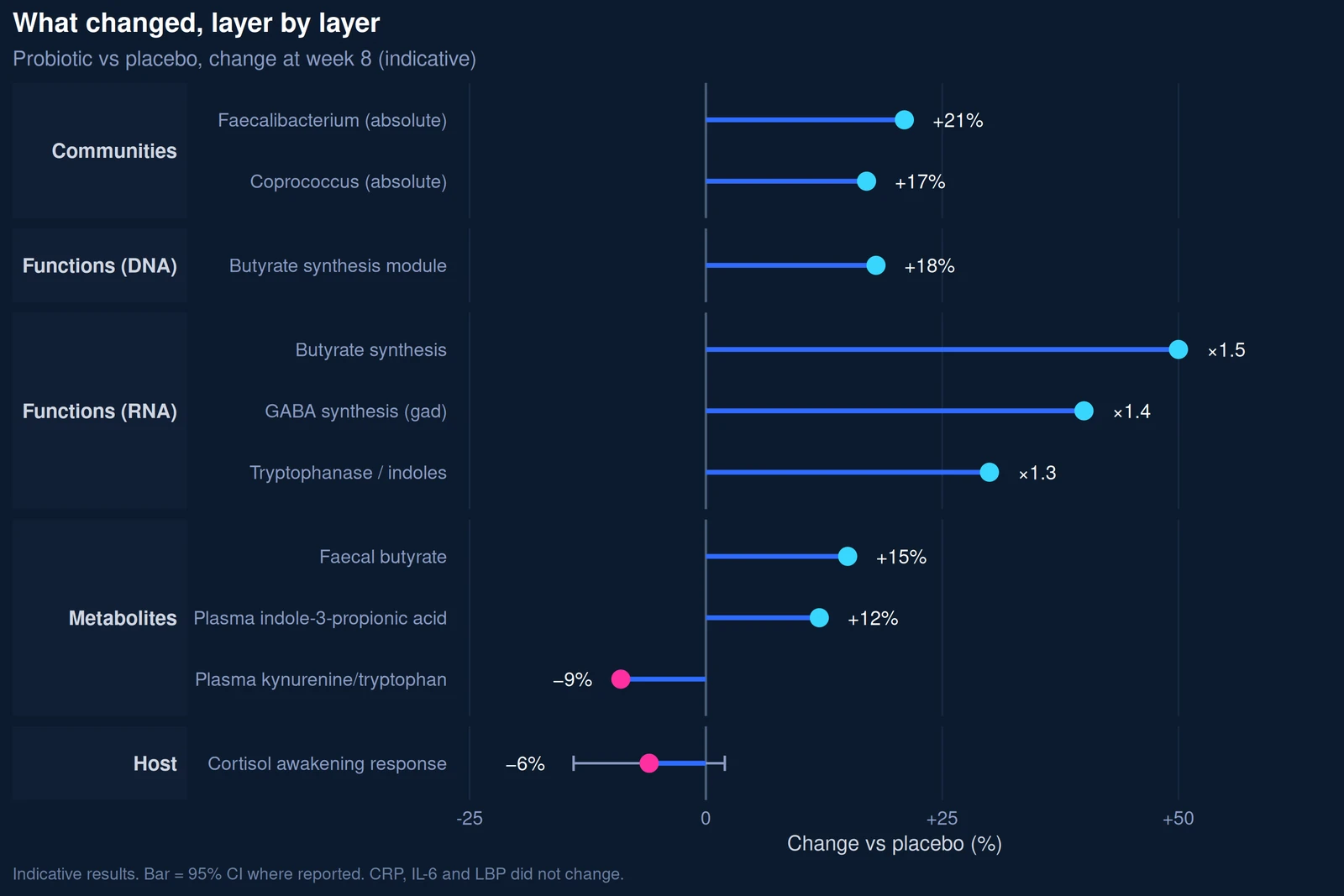
Key result Transient engraftment; butyrate, GABA and indole functions up; tryptophan shifted towards indoles; no change in inflammation or cortisol.
Illustrative scenario, not a client project
FAQ
16S describes community composition and diversity at a lower cost per sample. Shotgun is needed when the question involves functions, strains, resistance genes or low-abundance populations. Sequencing depth is set by the question and the sample complexity, not by a default.
Direct link to this questionMetagenomics says what a community can do. Metatranscriptomics shows which functions are actually expressed, and metabolomics measures what reaches the host. Metatranscriptomics and metabolomics on site, on the same collection, so the three layers can be read together.
Direct link to this questionStool, swabs, saliva, biopsies, blood, isolates, biofilms and environmental samples. Collection and storage protocols are agreed per matrix before sampling starts. For shipping, stool goes on dry ice and swabs at room temperature; quantities and conditions for every sample type are in the sample submission guidelines.
Direct link to this questionNot on its own. Microbiome Xplorer is a research service. Mechanistic data strengthen the scientific rationale and the design of a confirmatory study; they do not establish a claimed health effect, which in the EU requires authorization after EFSA assessment. Results are reported stating what the data support and what they do not.
Direct link to this questionA standard project takes 4–6 weeks, or 2–4 weeks with priority handling, counted in working days from GO, which is given after the visual check of your samples on reception. Larger programs are planned in milestones confirmed in the quote.
Direct link to this questionYes. Data is hosted in the EU, with backups in France, in a separate space per team. A mutual NDA can be signed before any detail is shared, at no charge.
Direct link to this questionA question for this program?