Transcriptomics
Differential expression at gene and pathway level, with predefined modules for aging, barrier or inflammation.
- Bulk RNA-seqcells, 3D skin, explants
- Pathway modulesGSEA
- Donor effectseparated from treatment
Xplorer™ program
Support your product claims with molecular evidence.
From the model to the interpretation, Skin Biology Xplorer™ shows how your cells, explants or 3D models respond to an active, which biological pathways are involved, and which claims the evidence can support. It includes our Cosmetics 360 offer.
CIR-approved 2026–2028Flagship offer
Cosmetics 360
Molecular efficacy evidence for cosmetic actives, in Essential, Advanced and 360 packages, from a single targeted measurement to integrated multi-omics.
What the program answers
A procollagen assay or an antioxidant test rarely answers what R&D teams ask. Skin Biology Xplorer characterizes what the active does, how it does it, and where the evidence stops.
Does the active measurably change skin biology, and by how much?
Which pathways does it act on, and do the transcriptomic, proteomic and metabolomic signals converge?
Is the effect reproducible across donors and models, or driven by one or two of them?
Which claims can the data support, with which wording, and which should not be made?
Where it is used
Omics layers
Differential expression at gene and pathway level, with predefined modules for aging, barrier or inflammation.
Protein-level confirmation by label-free LC-MS/MS, performed on a timsTOF Pro 2 (Bruker), matched against the transcriptomic result.
Antioxidant capacity, energy metabolism and lipids, measured on site in cells and tissues.
Epigenetic readouts, skin microbiome and extracellular vesicles and exosomes, added when the claim calls for them.
Cells, 3D models and skin explants are provided by partner laboratories.
Workflow
The target claim and the comparators (vehicle, reference active) come first, with the number of donors needed to tell an effect from donor variability.
Each model level answers a different question, with the same comparators.
Transcriptomics, proteomics and metabolomics on the same samples, with epigenomic, microbiome or vesicle modules where relevant.
An evidence map: a pathway counts as supported only when at least two independent layers or models agree.
Each candidate claim linked to its data, model and level of support, including those the data do not support.
Turnaround
Standard project
4–6 weeks
The usual pace for a project, confirmed in the quote.
Priority
2–4 weeks
When your schedule requires it, agreed at scoping and confirmed in the quote.
Counted in working days from GO, given once samples have passed visual QC on receipt. Larger programs are planned in milestones, each with its own date.
Turnaround times, service by serviceIllustrated case study
Case study · Healthy aging
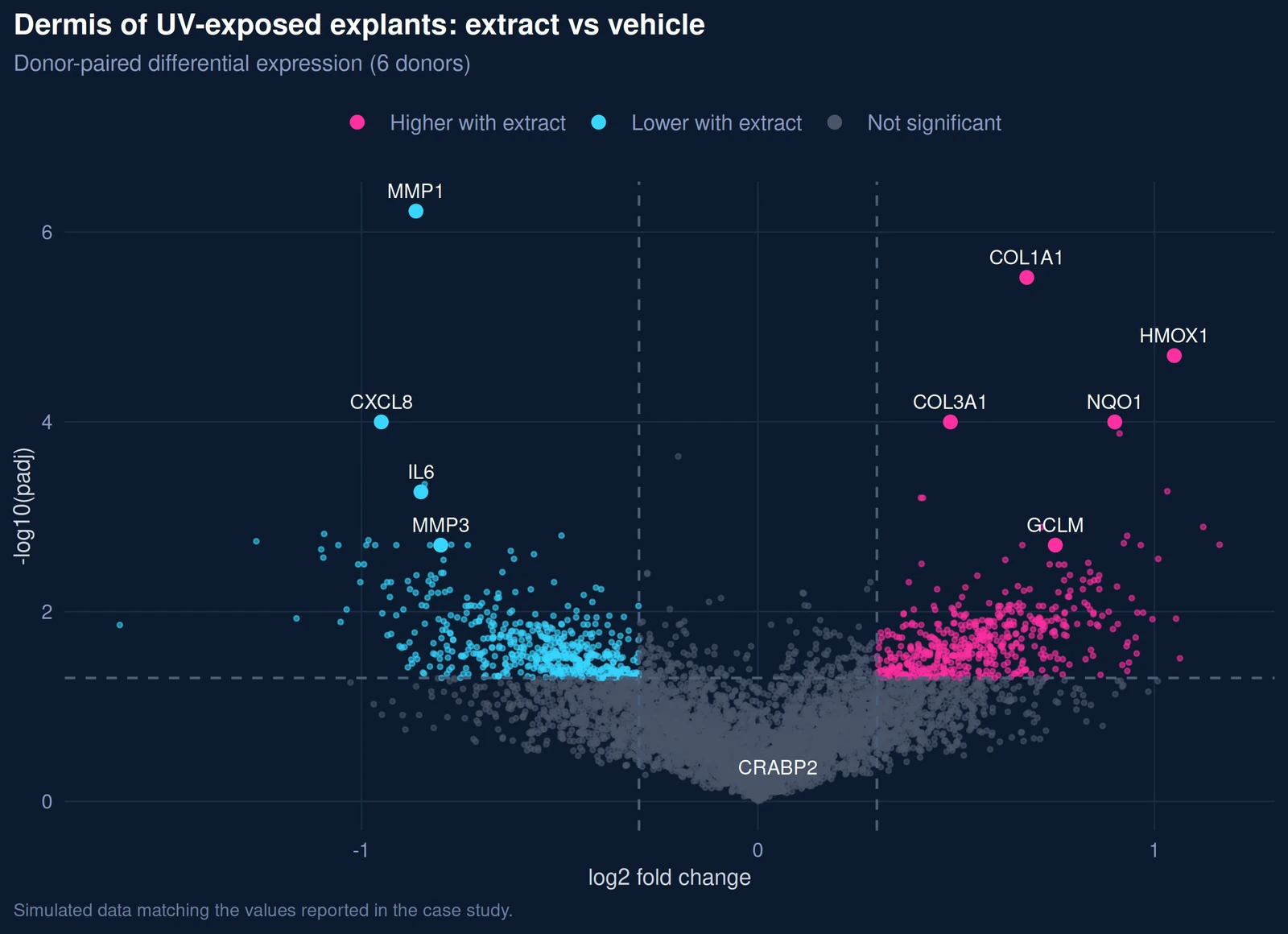
Key result 4 claims supported, 2 with restricted wording, 1 not supported; NRF2 antioxidant response, reduced senescence secretome and dermal-matrix preservation, with a non-retinoid profile.
Illustrative scenario, not a client project
FAQ
Cosmetics 360 is part of Skin Biology Xplorer: it is the program’s offer for cosmetic actives and finished products. Cosmetics 360 covers the full route from biological mechanism to proof of efficacy under one contract. Skin Biology Xplorer can also be scoped beyond Cosmetics 360.
Direct link to this questionYes, for mechanistic claims framed as in vitro or ex vivo findings, for example the pathway an active modifies in cells, reconstructed skin or explants. In vitro and ex vivo studies describe mechanisms; they do not replace a clinical evaluation. The model and the study design are adjusted to your active and to the claims you are aiming for.
Direct link to this questionCells and culture supernatants, reconstructed skin, ex vivo explants, biopsies, swabs and tape strips. Low-biomass material is handled with protocols chosen per matrix. Cells, 3D models and skin explants are provided by partner laboratories. Packaging and shipping rules for each sample type are in the sample submission guidelines.
Direct link to this questionOn site, by label-free LC-MS/MS with LFQ (label-free quantification) on a timsTOF Pro 2 (Bruker). The protein-level confirmation is set against the transcriptomic result. Metabolomics and lipidomics also run on site, measuring antioxidant capacity, energy metabolism and lipids in cells and tissues.
Direct link to this questionPlan 4–6 weeks as standard, or 2–4 weeks with priority handling, counted in working days from GO. GO is given after the visual check of your samples on reception. Larger programs are planned in milestones confirmed in the quote, so the date that binds us is the one written there.
Direct link to this questionIn the EU, with backups in France, in a separate space per team. A mutual NDA can be signed before any detail is shared.
Direct link to this questionA question for this program?