Genomics (DNA)
Somatic and germline variants, copy number and mutational signatures, summarized per sample and per group.
- WGS · WESgenome, exome
- Targeted panelsamplicons
- Copy numbersignatures
Xplorer™ program
Find the markers that separate two groups, and confirm them before you build on them.
Biomarker Xplorer™ reads DNA, RNA and proteins against the same question, from the isolation of biomolecules to a short list of candidates confirmed by targeted quantification. Designed by GENXMAP and run in our Marseille laboratories. Single-cell and spatial transcriptomics are available through Transcriptomics 360.
CIR-approved 2026–2028Flagship offer
Transcriptomics 360
One experimental design and one project lead across bulk, single-cell and spatial transcriptomics.
What the program answers
A single data layer, genomic, transcriptomic or proteomic, captures only part of a biological mechanism. Biomarker Xplorer combines them, so a candidate is supported by more than one measurement.
Which molecular features separate your groups: patients and controls, responders and non-responders, treated and untreated?
Which pathways and cell programs sit behind the signature, and do DNA, RNA and protein point the same way?
Which candidates hold up when measured by a targeted assay on more samples, or on a cohort they were not derived from?
Which short list is worth developing, and which candidates should be dropped now, with the evidence to say why?
Where it is used
Omics layers
Somatic and germline variants, copy number and mutational signatures, summarized per sample and per group.
Bulk RNA-seq profiles gene expression in each sample.
Protein-level quantification by label-free LC-MS/MS, performed on a timsTOF Pro 2 (Bruker), matched against the transcriptomic result.
Selected candidates measured by targeted assays on the full sample set, following MIQE and dMIQE guidance.
Single-cell and spatial transcriptomics are available through Transcriptomics 360.
Workflow
Groups, sample size and the split between discovery and confirmation are set before a single sample is run.
DNA, RNA and proteins extracted from tissues, blood, cells or biofilms; purity, concentration and integrity (RIN, RQN) checked before anything is sequenced.
Bulk RNA-seq in our laboratories for global expression profiles, with genomics and proteomics where the question needs them.
Versioned pipelines, differential analysis, GO, KEGG and Reactome enrichment and multi-omics integration narrow thousands of features to a testable few.
The short list is measured by qPCR or dPCR on the full sample set, and read against the question the study started from.
Deliverables
Practical terms
Turnaround
Standard project
4–6 weeks
The usual pace for a project, confirmed in the quote.
Priority
2–4 weeks
When your schedule requires it, agreed at scoping and confirmed in the quote.
Counted in working days from GO, given once samples have passed visual QC on receipt. Larger programs are planned in milestones, each with its own date.
Turnaround times, service by serviceIllustrated case study
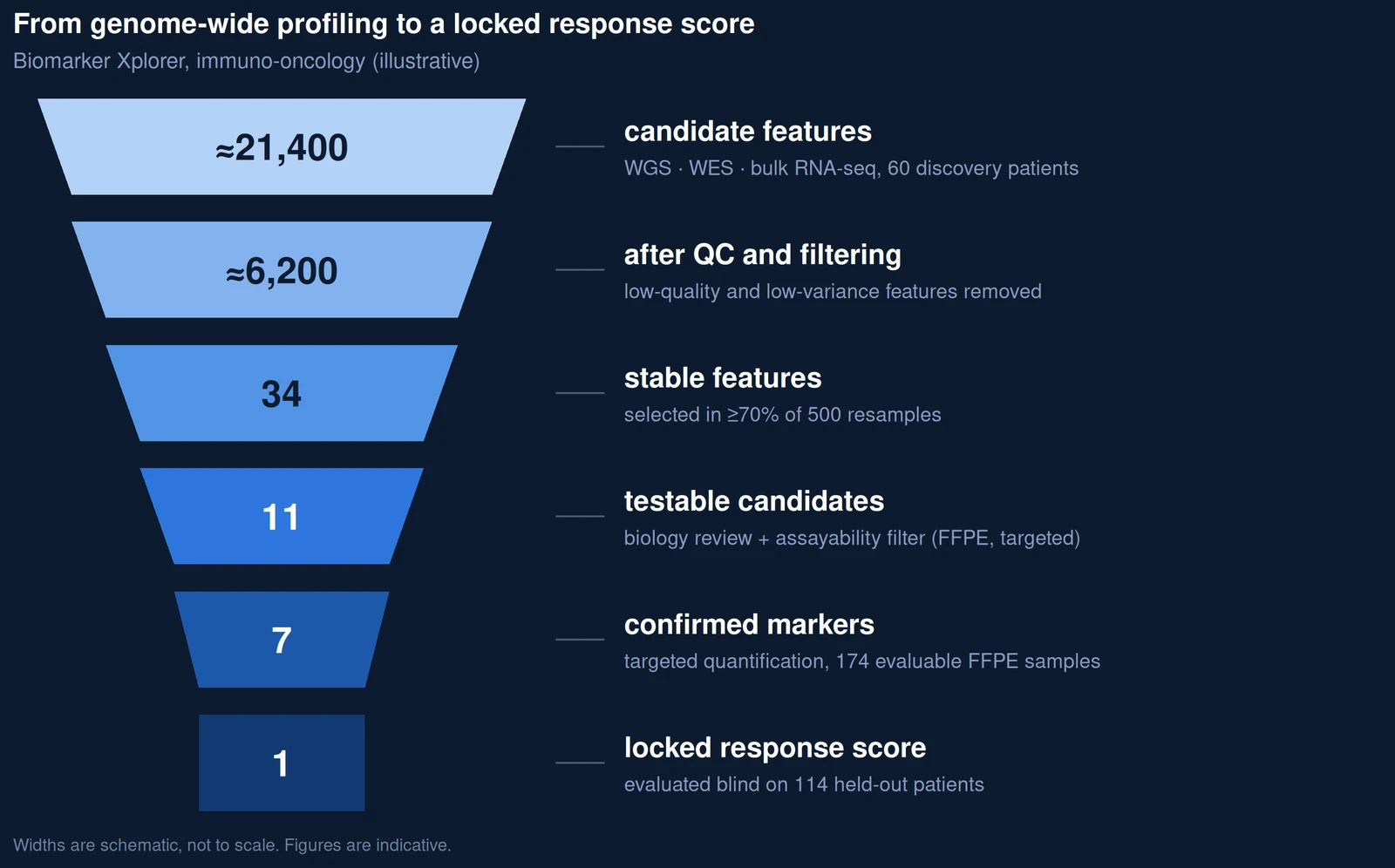
Case study · Immuno-oncology
Key result 7 confirmed markers combined in one locked score; held-out AUC 0.78 against 0.62 for PD-L1 IHC alone.
Illustrative scenario, not a client project
FAQ
Discovery measures thousands of features on a limited number of samples to find candidates. Confirmation measures a short list by targeted assay (qPCR, dPCR or amplicon panels) on more samples, ideally on a cohort the candidates were not derived from. A candidate that does not hold up is reported as such.
Direct link to this questionNot directly. Bulk RNA-seq runs in our Marseille laboratories, alongside genomics and proteomics when the question calls for them. Single-cell and spatial transcriptomics are available through Transcriptomics 360, which runs bulk, single-cell and spatial on one experimental design, under one GENXMAP contract and one project lead.
Direct link to this questionProteomics is performed on site by label-free LC-MS/MS with LFQ (label-free quantification) on a timsTOF Pro 2 (Bruker). The protein-level result is set against the transcriptomic result, and a short list of candidates is then confirmed by targeted assay (qPCR, dPCR or amplicon panels) on more samples.
Direct link to this questionYes. Genomic, transcriptomic or proteomic data from an earlier study or another provider can be analyzed and integrated on its own terms. What matters is the biological question and the metadata that came with the data. We tell you what the data can and cannot support before proposing an analysis.
Computational Biology & AI Modeling
Direct link to this questionA standard project takes 4–6 weeks, or 2–4 weeks with priority handling, counted in working days from GO. GO is given after the visual check of your samples on reception, once the QC report has been generated. Larger programs are planned in milestones confirmed in the quote.
Direct link to this questionOnly the people you authorize: each team works in a separate space, with data hosted in the EU and backups in France. A mutual NDA can be signed before any detail is shared, at no charge.
Direct link to this questionA question for this program?